
It helps, sometimes to have what you will later think is a simple process explained in a clear and steady tone. So let us try and accomplish that. To begin with:
The most common series of events when printing packaging is:
Print, Cut, Glue, Assemble
It is very important to understand this as a series of events because it gives a good indication of what is required at each stage in relation to your artwork.
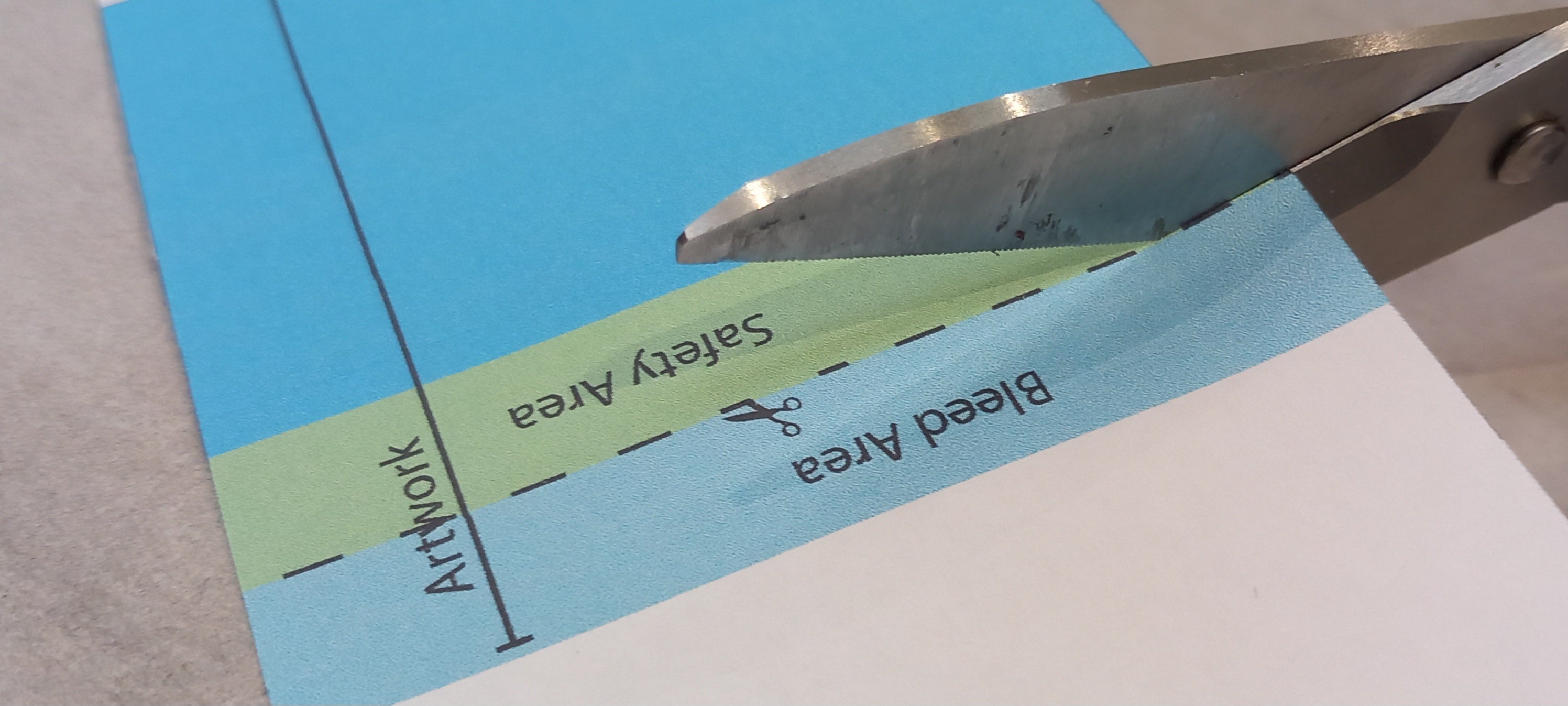
A simple try-at-home scenario explains bleed: If you have a printer, print a square on a piece of paper. Now try and cut the square out with a pair of scissors. Your aim is to have a clean square with no white on it and the white surround with no colour from the square. If you have no printer, try cutting a picture out of the newspaper exactly on the border!
Unless you have the fine motor skills of a seriously expensive robot from a long off future, chances are, you will not have a completely clean cut square.
When we print on a large quantity scale with machines, the process is simply only as accurate as hand cutting when it comes to position and therefore needs a little bit of space either side of where the desired cut is to be. Our machines ensure lines are straight and the cut is clean, but the overall position on the print can be up to 1mm either way. Consider how small 1mm is and that is pretty accurate.
Bleed is the amount of print that goes beyond the edges of the cut line to allow this tolerance to happen. 3mm bleed is all that is required, but is very important to ensure a clean looking finish to your prints.
Similarly to bleed, a safety margin is required on the inside of the cut line, to protect necessary content. Alpha Duplication has a 2mm safety margin on every specification, though it is common for print houses to have 3-5mm safety.
Our image on this post shows the thousand words we hope necessary to understand the concept, but we also understand that communication is different for everybody, so just ask you printers art department if you are unsure.


