
Printmaking is an art form that allows us to produce artworks through techniques of multiplication, creating multiples of a single image. Which technique to use is often a choice underestimated in it's value because we have become so used to commercial printers taking the manufacturing task and all it's twists and turns away from the end user/ buyer.
There are three main types of commercial printing and a couple of sub-divisions in one or two of them. We use all three types when we print disc on body art and for some of the higher value effect sleeves that we print we use all three more than once. Here's the skinny on the print processes:
Screen Printing is the act of physically pushing ink through a screen mesh. The screens used to be made out of silk, but are now made of a polyester/nylon thread. The silk screen most commonly has an image "burned" into a photosensitive chemical blocking areas where ink is not to travel through using light. It results in an affective stencil sitting in the woven mesh. The mesh will then keep the ink sitting on top of it until pushed through the stencil with a squeegee onto the substrate (paper/card/disc) leaving an even coat. A different screen would be needed for each colour and the substrate registered perfectly.
Screen printing is typically associated with T-shirt printing in modern manufacture, but for certain types of artwork, we use it for the CD on body print and don't underestimate it's uses on paper and cardboard.. It can have a superior finish to certain details compared to lithographic printing colours and can match pantone colours exactly if applicable. If Pantone matches are required as an exact match in printed packaging, they can be utilised through a screen and traditionally UV spot gloss or matt effects are applied using screen printing techniques. Screen printing is versatile in that it can be accomplished both my hand or by automatic machine and due to it's open nature, all sorts of different types of ink can be used on a huge variety of substrates, paper, card, plastics, metals, fabrics, ceramics.
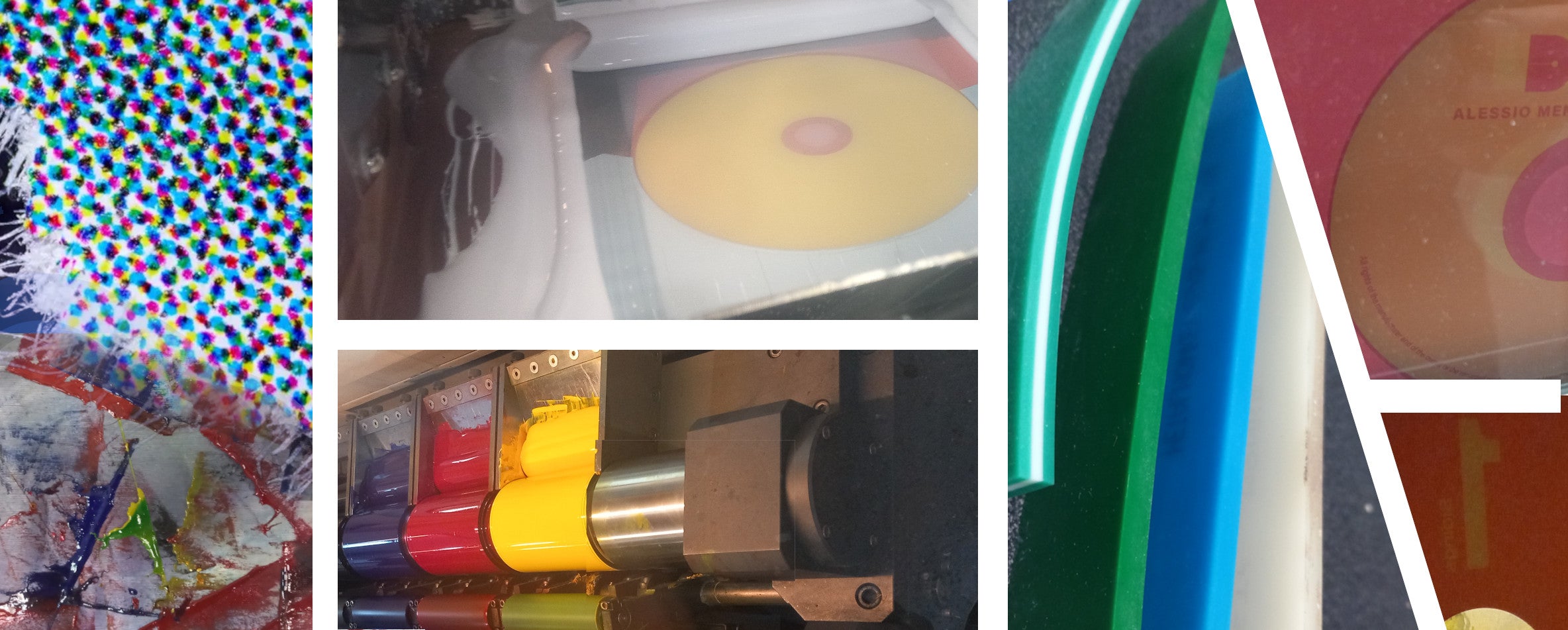
The image below is the screen printed white base that is applied before the CDs rotate around to our lithographic press. You can see the ink sitting on top, being pushed through with the motion of the squeegee.

Lithographic printing is quite different and it's full name is Offset Lithographic printing. There are some similarities to screen printing in that on press contains one colour. The difference is that a 4 colour set up has 4 presses one after the other and the sheet flows rapidly through all four presses. It is common for a 5th press to be at the end containing a varnish or seal for the product as a final stage and many manufacturers invest in a 6th press to utilise as a specific colour or effect varnish.
This all sounds a little complex and although bits of it are, on the whole it's quite simple. The 4 colours, CMYK, are the principle print colours and can make up a huge array of tones. Our 4 main Lithographic presses contain one colour each. As the sheets move through the presses a fine array of dots (300 dots per quare inch total) is applied in various densities and when the sheet gets to the end, the variable dot densities produce the original image that was sought after. There's a bit more to it than that, things like the 10 or so inking system rollers and the computer made printing plates, but we can leave that for another day.
Our factory prints full colour lithographic images onto the media disc in the same way, but with one roller moving back and forth over an a revolving station. This actually explains the process very well as it is an open to view machine and has one roller because the CD area is so small. In the image below you can see the colour wells with CMYK nearest us, then the roller that has the press plates on, collecting the ink on it's way to the CD blanks. The semi circle (a full circle in fact) in furthest from us rotates and so the CDs are printed with each colour in turn.

To see either Screen Printing or Lithographic printing in motion, see the header on our home page for some video footage.
Finally we can look at the term "Digital Printing". This term can have a bad reputation sometimes, but it is important to remember that it has many different types of printer under it's umbrella. There are 3 main categories of Inkjet, Toner & Liquid Electrophotography. The last one is almost specific to a printer made by Hewlett Packard called an Indigo and is the most modern method. It can match high quality Offset Lithographic Printing, has a simple set up, but is not quite as fast. Leaving the Liquid Electrophotography to one side for a moment...
Inkjet and toner printing are available in the home environment. Inkjet depositing ink through tiny little jets and toner imprinting through heated dry powders, sealed to the card or paper. Commercial digital printing is the same technology with significantly more refinement at a much larger scale. Toner printing is the better to offer both high speed and quality, producing deep tones and crisp lines. Inkjet printing is usually considerably slower, but the technology can produce incredibly high quality prints and some machines can now produce raised spot gloss effects in the same build as the colour printer.
Toner based digital printing is the most common commercial printing practice and is utilised for a huge array of products. Most local leaflets, flyers, letters, business cards and posters will be toner printer and packaging under a certain size and quantity is common. It's the best balance between speed and quality for runs of 10s to a few hundred or thousand before crossing the boundaries into the higher volume and speed of lithographic print.
We house almost all of these methods within our production facility utilised for various substrates and enjoy them re-schooling us every day and increasing our own education within the field. Every day is indeed a school day.


